Research interests
I am a Senior Research Scientist at Natural Resources Canada (NRCan) in Ottawa, Canada. My research is in radar remote sensing of ground deformation, with a focus on Interferometric Synthetic Aperture Radar (InSAR). I develop methods that turn large archives of satellite SAR data, from missions such as Sentinel-1, RADARSAT-2 and the RADARSAT Constellation Mission, into precise, high-resolution measurements of how the Earth's surface moves over time. This work spans the full processing chain, from interferogram generation and time-series inversion to the geophysical interpretation of the resulting deformation.
A central theme is combining measurements from multiple satellites and viewing geometries to recover the full multidimensional (2D and 3D) deformation field and its evolution in time. I apply these methods across a broad range of processes, including earthquakes, volcanic activity, landslides, glacier motion, urban and coastal subsidence, groundwater, oil and gas extraction, and mining and post-mining ground movement. To support this work I developed MSBAS (Multidimensional Small Baseline Subset), an open method and software that integrates InSAR and speckle range and azimuth offset data into multidimensional ground-deformation time series.
My current work focuses on next-generation InSAR technologies and national-scale ground-deformation products: automated, cloud-scale processing; analysis-ready data and big-data approaches for continuous, near-real-time monitoring; and multi-sensor fusion to deliver decision-ready products for hazard assessment, infrastructure monitoring, and early warning.
I am also the founder of INSAR Corporation (insarcorp.com), a company that provides satellite InSAR ground-deformation monitoring services to mining, energy, and infrastructure clients worldwide.
Research highlight
Pilot deformation map of Canada
I produced a pilot national-scale map of active ground-deformation processes across Canada, computed on a high-performance Linux cluster. It is derived from Sentinel-1 radar data acquired during the snow-free seasons of 2017 to 2024, processed with MSBAS Version 10, and provides line-of-sight, east-west horizontal, and vertical deformation rates. Long-wavelength signals from postglacial rebound and tectonic motion were removed to bring out small-scale processes such as landslides and ground movement from mining. This is an early, exploratory product: field studies have so far confirmed only a few of the detected processes, and the maps still contain processing artifacts. Considerable work remains to resolve these issues and to validate the signals, which is the focus of ongoing research.
The dataset can be downloaded from geo.ca. Many of the deformation features cover small areas, so they become visible only when you zoom in on the map.
Recent papers
2024Multidimensional Small Baseline Subset (MSBAS) software for partially coherent DInSAR and speckle offset data. Canadian Journal of Remote Sensing.
The release paper and user manual for MSBAS Version 10. It documents the parallelized software (OpenMP and MPI/OpenMP) that computes 1D, 2D, constrained and unconstrained 3D, and 4D deformation time series from InSAR and speckle-offset data, built for the large datasets of modern SAR missions. New results include landslides in the Northwest Territories, Argentina, and Colombia, tectonic deformation and subsidence in Turkey and Yemen, and a 4D time series of glacier flow and surge at the Malaspina Glacier, Alaska.
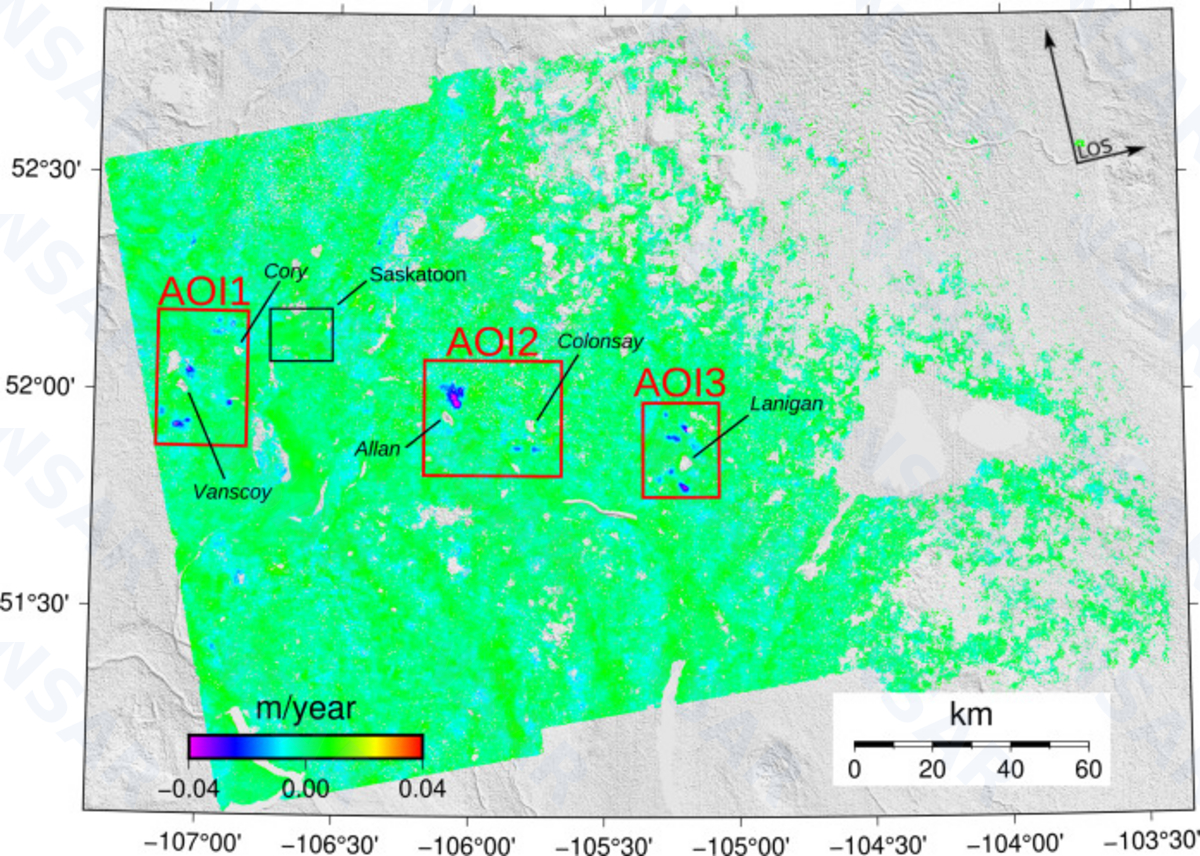
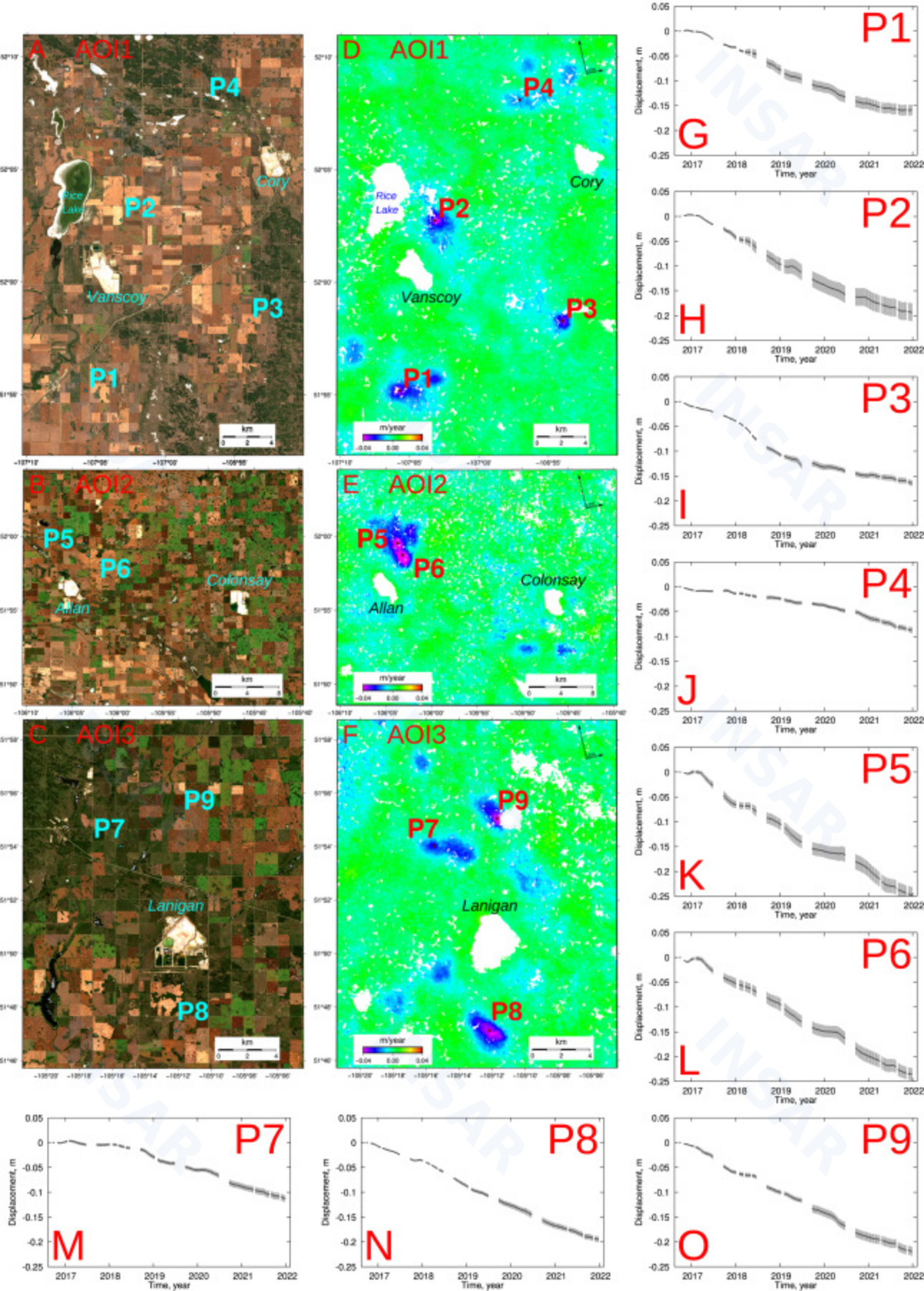
2024Ground deformation due to natural resource extraction in the Western Canada Sedimentary Basin. Remote Sensing Applications: Society and Environment.
Ground deformation across the Western Canada Sedimentary Basin is linked to natural resource extraction using Sentinel-1, RADARSAT-2, and RCM data from 2015 onward. MSBAS 2D time series mapped long-lasting deformation from steam-assisted gravity drainage and cyclic steam stimulation oil recovery and from coal and potash mining, while individual interferograms captured induced and slow-slip earthquakes. The deformation style varied strongly with technique and depth, and several of the observed signals may precede more consequential events.
2024Estimating volume of large slow-moving deep-seated landslides in northern Canada. Remote Sensing of Environment.
Large slow-moving deep-seated landslides in Alberta and the Northwest Territories are characterized using 2D and constrained 3D deformation rates from ascending and descending Sentinel-1 (2017 to 2022). East-west motion proved more diagnostic than vertical motion, and Aspect-Parallel Flow constrained 3D rates were used to estimate landslide thickness and volume. The estimated thickness of the Northwest Territories landslide reaches about 100 m, suggesting that an entire permafrost block may be sliding.
2023Deformation retrievals for North America and Eurasia from Sentinel-1 DInSAR: a big data approach. Canadian Journal of Remote Sensing.
A big-data approach to ground-deformation monitoring: a fully automated InSAR processing system that measures long-term deformation time series and rates frame by frame. It computed deformation rates from 2017 to 2023 across large parts of North America and Eurasia from more than 220,000 Sentinel-1 images, revealing many previously unknown deformation processes, including large slow-moving landslides in Canada, oil-field subsidence in the Russian Arctic and Kazakhstan, and large subsiding regions in Iran and China. The computed deformation rates are openly available for download.
2023Satellite interferometry for regional assessment of landslide hazard to pipelines in northeastern British Columbia. International Journal of Applied Earth Observation and Geoinformation.
A regional assessment of landslide hazard to pipelines in northeastern British Columbia, comparing deformation maps from commercial RADARSAT-2 and free Sentinel-1 data. Sentinel-1 alone produced high-quality maps capable of detecting slow-moving landslides; hundreds were identified with Getis-Ord Gi* hotspot analysis, and two areas of significant activity near pipelines were examined in detail and confirmed by field observations.
2021SAR-derived flow velocity and its link to glacier surface elevation change and mass balance. Remote Sensing of Environment.
A method linking SAR-derived glacier flow velocity to surface elevation change and specific mass balance. Four-dimensional flow displacement time series from ascending and descending Sentinel-1 (2016 to 2019) over southeast Alaska are split into a Surface-Parallel Flow advection component and a non-Surface-Parallel Flow component, the latter connecting elevation change with mass balance and strain rates. The seasonal signal is modeled with a Positive Degree Day model, and the method can yield either mass balance or elevation change when the other is known.
2020Satellite interferometry for surface deformation in one, two, and three dimensions: the MSBAS-3D method. Engineering Geology.
This paper introduces MSBAS-3D, an extension of MSBAS that produces full three-dimensional (north, east, and vertical) surface-deformation time series from ascending and descending InSAR data, rather than the single line-of-sight component of conventional InSAR. It targets processes with motion parallel to the surface, such as landslides and glacier flow, while preserving InSAR accuracy. The method is demonstrated on a large, slow-moving, deep-seated landslide with long InSAR and dGNSS records, where the 3D time series substantially simplifies interpretation compared with 1D and 2D analysis.
MSBAS
Multidimensional Small Baseline Subset (MSBAS) is the technique and open-source software at the core of my work, for computing ground-deformation time series from radar satellite data. It simultaneously processes multiple ascending and descending InSAR datasets, together with range and azimuth speckle-offset datasets, acquired by different sensors and in different line-of-sight geometries. By combining them, MSBAS separates the deformation into its physical components and merges their acquisition times into a single series with higher temporal resolution over the overlapping area.
Depending on the input, it produces one-, two-, three-, and four-dimensional results: vertical and east-west horizontal motion in 2D; Surface-Parallel Flow and Aspect-Parallel Flow constrained, or fully unconstrained, 3D motion; and 4D time series such as glacier flow and surge. The underlying system of equations is usually rank deficient and is solved in the least-squares sense by singular value decomposition with zero-, first-, or second-order Tikhonov regularization. The core is written in C++ and uses the LAPACK linear algebra library.
The current release, Version 10, is parallelized with OpenMP and MPI and is optimized for the very large datasets produced by modern missions such as multi-frame Sentinel-1; it runs on both workstations and clusters and supports fully and partially coherent pixels. MSBAS has been applied to a wide range of processes: earthquakes and tectonic deformation, volcanic activity, landslides, glacier flow and surge, and subsidence and uplift from groundwater, hydrocarbon, and mining activity.
Software and user manual: https://doi.org/10.4095/pbcc4f9bv3; method paper: https://doi.org/10.1080/07038992.2024.2424753. Full details and applications are in the references below.
MSBAS references
1D and 2D
-
Samsonov, S. and d'Oreye, N. (2012). Multidimensional time series analysis of ground deformation from multiple InSAR data sets applied to Virunga Volcanic Province. Geophysical Journal International, 191, 1095-1108.
https://doi.org/10.1111/j.1365-246X.2012.05669.x -
Samsonov, S., d'Oreye, N., and Smets, B. (2013). Ground deformation associated with post-mining activity at the French-German border revealed by novel InSAR time series method. International Journal of Applied Earth Observation and Geoinformation, 23, 142-154.
https://doi.org/10.1016/j.jag.2012.12.008 -
Samsonov, S., Gonzalez, P., Tiampo, K., and d'Oreye, N. (2013). Spatio-temporal analysis of ground deformation near Rice Lake, Saskatchewan, observed by Radarsat-2 DInSAR (2008-2011). Canadian Journal of Remote Sensing, 39, 27-33.
https://doi.org/10.5589/m13-005 -
Samsonov, S.V., Tiampo, K.F., Camacho, A.G., Fernandez, J., and Gonzalez, P.J. (2014). Spatiotemporal analysis and interpretation of 1993-2013 ground deformation at Campi Flegrei, Italy, observed by advanced DInSAR. Geophysical Research Letters, 41, 6101-6108.
https://doi.org/10.1002/2014GL060595 -
Samsonov, S., d'Oreye, N., Gonzalez, P., Tiampo, K., Ertolahti, L., and Clague, J. (2014). Rapidly accelerating subsidence in the Greater Vancouver region from two decades of ERS-ENVISAT-RADARSAT-2 DInSAR measurements. Remote Sensing of Environment, 143, 180-191.
https://doi.org/10.1016/j.rse.2013.12.017 -
Samsonov, S., Gonzalez, P., Tiampo, K., and d'Oreye, N. (2014). Modeling of fast ground subsidence observed in southern Saskatchewan (Canada) during 2008-2011. Natural Hazards and Earth System Sciences, 14, 247-257.
https://doi.org/10.5194/nhess-14-247-2014 -
Samsonov, S.V., Trishchenko, A.P., Tiampo, K., Gonzalez, P.J., Zhang, Y., and Fernandez, J. (2014). Removal of systematic seasonal atmospheric signal from interferometric synthetic aperture radar ground deformation time series. Geophysical Research Letters, 41, 6123-6130.
https://doi.org/10.1002/2014GL061307 -
Samsonov, S., Czarnogorska, M., and White, D. (2015). Satellite interferometry for high-precision detection of ground deformation at a carbon dioxide storage site. International Journal of Greenhouse Gas Control, 42, 188-199.
https://doi.org/10.1016/j.ijggc.2015.07.034 -
Samsonov, S., Feng, W., Peltier, P., Geirsson, H., d'Oreye, N., and Tiampo, K. (2017). Multidimensional Small Baseline Subset (MSBAS) for volcano monitoring in two dimensions: Piton de la Fournaise case study. Journal of Volcanology and Geothermal Research, 344, 121-138.
https://doi.org/10.1016/j.jvolgeores.2017.04.017 -
Samsonov, S.V., Lantz, T.C., Kokelj, S.V., and Zhang, Y. (2016). Growth of a young pingo in the Canadian Arctic observed by RADARSAT-2 interferometric satellite radar. The Cryosphere, 10, 799-810.
https://doi.org/10.5194/tc-10-799-2016 -
Samsonov, S.V., Tiampo, K.F., and Feng, W. (2016). Fast subsidence in downtown Seattle observed with satellite radar. Remote Sensing Applications: Society and Environment, 4, 179-187.
https://doi.org/10.1016/j.rsase.2016.10.001 -
Samsonov, S. and d'Oreye, N. (2017). Multidimensional Small Baseline Subset (MSBAS) for Two-Dimensional Deformation Analysis: Case Study of Mexico City. Canadian Journal of Remote Sensing, 43, 318-329.
https://doi.org/10.1080/07038992.2017.1344926 -
Samsonov, S. (2017). Short- and long-term ground deformation due to cyclic steam stimulation in Alberta, Canada, measured with interferometric radar. The Leading Edge, 36, 36-42.
https://doi.org/10.1190/tle36010036.1 -
Samsonov, S. (2019). User manual, source code, and test set for MSBASv3 for one- and two-dimensional deformation analysis. Geomatics Canada, Open File 45, 13 pages.
https://doi.org/10.4095/313749 -
Samsonov, S. and Baryakh, A. (2020). Estimation of deformation intensity above a flooded potash mine near Berezniki (Perm Krai, Russia) with SAR interferometry. Remote Sensing, 12, 3215.
https://doi.org/10.3390/rs12193215 -
Samsonov, S. and Blais-Stevens, A. (2023). Satellite interferometry for regional assessment of landslide hazard to pipelines in northeastern British Columbia, Canada. International Journal of Applied Earth Observation and Geoinformation, 118, 103273.
https://doi.org/10.1016/j.jag.2023.103273 -
Samsonov, S.V., Feng, W., Blais-Stevens, A., and Eaton, D.W. (2024). Ground deformation due to natural resource extraction in the Western Canada Sedimentary Basin. Remote Sensing Applications: Society and Environment, 34, 101159.
https://doi.org/10.1016/j.rsase.2024.101159
3D (SPF-constrained)
-
Samsonov, S. (2019). Three-dimensional deformation time series of glacier motion from multiple-aperture DInSAR observation. Journal of Geodesy, 93, 2651-2660.
https://doi.org/10.1007/s00190-019-01325-y -
Samsonov, S., Dille, A., Dewitte, O., Kervyn, F., and d'Oreye, N. (2020). Satellite interferometry for mapping surface deformation time series in one, two, and three dimensions: A new method illustrated on a slow-moving landslide. Engineering Geology, 266, 105471.
https://doi.org/10.1016/j.enggeo.2019.105471
3D
-
Samsonov, S., Tiampo, K., and Cassotto, R. (2021). Measuring the state and temporal evolution of glaciers in Alaska and Yukon using SAR-derived 3D time series of glacier surface flow. The Cryosphere, 15, 4221-4239.
https://doi.org/10.5194/tc-15-4221-2021 -
Samsonov, S., Tiampo, K., and Cassotto, R. (2021). Data for: Measuring the state and temporal evolution of glaciers in Alaska and Yukon using SAR-derived 3D time series. Mendeley Data, V1.
https://doi.org/10.17632/zf67rsgydv.1
4D
-
Samsonov, S., Tiampo, K., and Cassotto, R. (2021). SAR-derived flow velocity and its link to glacier surface elevation change and mass balance. Remote Sensing of Environment, 258, 112343.
https://doi.org/10.1016/j.rse.2021.112343 -
Samsonov, S., Tiampo, K., and Cassotto, R. (2020). Data for: SAR-derived flow velocity and its link to glacier surface elevation change and mass balance. Mendeley Data, V1.
https://doi.org/10.17632/9d96c5bddm.1 -
Samsonov, S.V. and Blais-Stevens, A. (2024). Estimating volume of large slow-moving deep-seated landslides in northern Canada from DInSAR-derived 2D and constrained 3D deformation rates. Remote Sensing of Environment, 305, 114049.
https://doi.org/10.1016/j.rse.2024.114049